

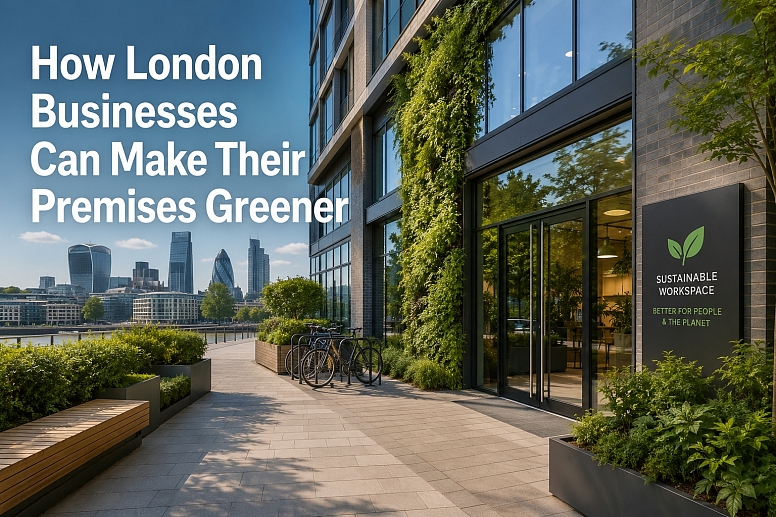
How London Businesses Can Make Their Premises Greener
Greener business premises are not created by adding a few environmental claims to the website or replacing one product with a version labelled “sustainable”.
Real progress is more practical. It comes from understanding how the property is used, where materials are wasted, how much water and energy the operation needs, and which improvements will remain useful after the first burst of enthusiasm has passed.
That matters in London, where businesses operate from a varied mix of buildings. Your premises might be a compact shop, a converted townhouse, a restaurant, a hotel, a shared office, a warehouse or part of a mixed-use development. Each setting creates different constraints. Space is limited. Deliveries can be complicated. Refurbishment may need careful planning. Customers still expect the place to look good and work properly.
The answer is not to attempt every green upgrade at once. Start with the decisions that match your property, your budget and the way your team actually works. Small changes can reduce repeated waste. Larger projects may improve long-term resilience. Both need a clear purpose.
Begin with how the premises are actually used.
Before buying new products or commissioning a major upgrade, watch what happens during an ordinary working day.
When do staff arrive? Which areas are occupied continuously, and which sit empty for long periods? How often do promotional displays change? Where is water used? What is thrown away because nobody has a practical way to store or reuse it?
A restaurant may use substantial water in kitchens and toilets while replacing menus, window graphics and promotional boards throughout the year. A retailer may discard display materials after every seasonal campaign. An office with hybrid working may continue heating and lighting areas that are rarely full. A hotel may have strong maintenance procedures in guest rooms but recurring waste in deliveries or back-of-house spaces.
Speak to the people who work in the building. They know which taps leak, which cupboards contain forgotten materials and which equipment is left running because no one is sure who should switch it off. They also know when an apparently sensible environmental measure is too awkward to use in practice.
Create a simple baseline. Review water and energy bills, purchasing records, waste collections and maintenance reports. You do not need perfect data. You need enough evidence to identify repeated problems and decide where a closer investigation is worthwhile.
Sustainability becomes manageable when it is connected to ordinary operations rather than treated as a separate campaign.
Choose visible materials that can be used more than once.
Customer-facing materials deserve more scrutiny than they often receive.
Shops, cafés, hotels, offices and event teams regularly use signs, banners, branded backdrops, table coverings, lanyards and wayfinding displays. These items may be inexpensive individually, but repeated replacement creates cost, storage problems and avoidable waste.
Start by asking how long the message needs to last. A permanent entrance sign, a seasonal promotion and a one-day event require different solutions. If the wording changes frequently, consider whether the frame or structure can remain in use while only the graphic is replaced.
When a business refreshes its branding throughout the year, selecting reusable or lower-waste eco-friendly signage options can reduce the amount of material discarded after each campaign, with Printroom offering formats such as PVC-free banners, recycled-material lanyards and reusable fabric displays.
The environmental label should not end the assessment. Check whether the product is durable enough for the intended location, whether replacement graphics are available, and whether you have somewhere suitable to store it between uses. A reusable display damaged through poor storage has not delivered much value.
Keep the message clear as well. More sustainable material does not compensate for unreadable text or confused design. Use strong contrast, limited wording and a layout suited to the viewing distance. For outdoor displays, consider weather exposure and safe fixing. For indoor use, think about how quickly staff can assemble and pack the item.
Good signage should make the premises easier to understand while remaining useful for more than one short campaign.
Reduce waste through purchasing and maintenance.
Procurement decisions shape the environmental performance of premises long before anything enters a recycling bin.
The cheapest item may need frequent replacement. A supposedly durable product may be difficult to repair. Bulk ordering can reduce delivery frequency but create waste if the business lacks suitable storage or demand changes.
Ask a few consistent questions. How long should the item last? Can one component be replaced without discarding the whole product? Is it easy to clean or repair? What packaging will arrive with it? Will staff actually use it as intended?
Apply the same thinking to furniture, cleaning products, equipment, uniforms, promotional materials and fit-out components. Refillable products may work well where teams follow a clear routine. Repairable furniture may justify a higher upfront cost. Consolidated ordering can reduce repeated deliveries, but only where stock control prevents overbuying.
Maintenance belongs in the same conversation. A leaking tap wastes water. A damaged door can allow conditioned air to escape. Poorly maintained equipment may consume more resources and fail earlier.
Give someone ownership. Record faults, assign actions, and check whether the repair solved the underlying problem. If the same issue returns, stop treating each call-out as an isolated event.
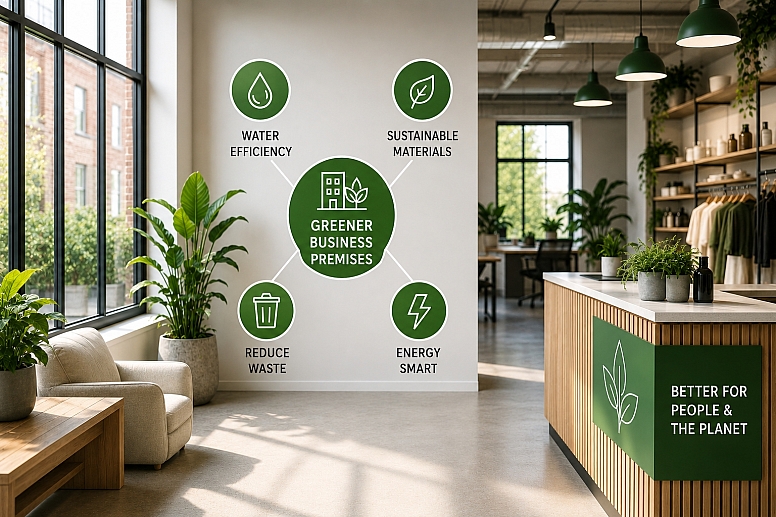
Greener premises are usually better-maintained premises.
Treat water as an operational resource.
Water use is easy to overlook because it is built into so many routine activities.
Toilets, kitchens, cleaning, irrigation, vehicle washing and some cooling or production processes can all create demand. In small premises, the priority may be fixing leaks and checking fixtures. In a larger building, you may need metering by area or a structured water audit.
Begin with bills and meter readings. Look for unexplained changes. Compare similar periods rather than assuming that every increase represents waste. A busier hotel or restaurant will naturally use more water, so relate consumption to occupancy or output where possible.
Check the basics on site. A slowly running toilet cistern can remain unnoticed for months. External taps may be used without anyone monitoring them. Cleaning routines may rely on more water than necessary simply because that is how the task has always been done.
London City Hall encourages businesses and property managers to view rainwater as a valuable resource, rather than sending all of it directly into drains and sewers. That principle is useful even before a major project is considered: understand what water quality is needed for each activity and avoid using treated mains water automatically where an alternative may be feasible.
Any reuse arrangement still needs proper design, clear separation from drinking-water supplies and ongoing maintenance. The goal is not to improvise. It is to investigate whether the building has a genuine opportunity to use water more intelligently.
Assess whether collecting rainwater suits the property.
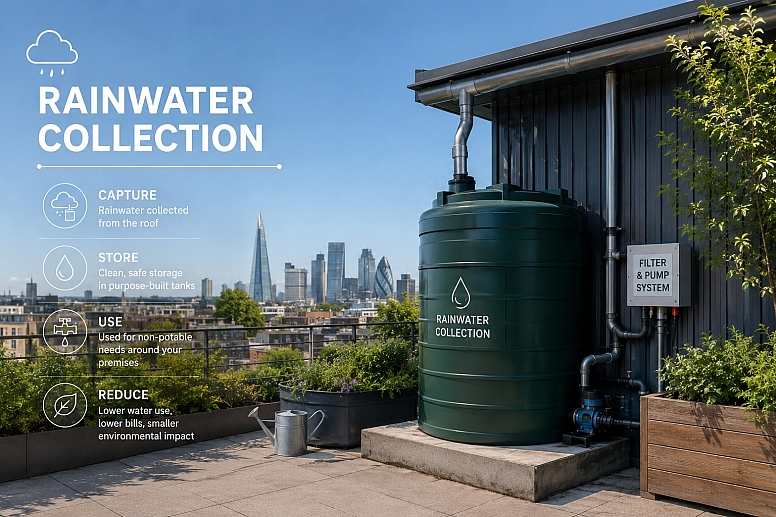
Rainwater harvesting is more than placing a tank beneath a downpipe.
A commercial system may involve roof collection, drainage routes, storage, filtration, pumps, controls and treatment appropriate to the intended use. Its feasibility depends on the roof area, rainfall, available space, pattern of demand and the ability to maintain the equipment.
For larger buildings with substantial roofs and a consistent need for non-potable water, commercial rainwater collection systems may form part of a broader water-efficiency plan, with CapCon Engineering providing design, tank sizing, filtration, controls, installation and maintenance support.
Start with demand rather than the equipment. Where could collected water realistically be used? Toilet flushing, irrigation, vehicle cleaning or certain maintenance activities may be possibilities, subject to the design and relevant requirements. If demand is low or highly seasonal, a large installation may be difficult to justify.
Storage also matters. Tanks require space and coordination with the rest of the building. Pumps and controls need power and maintenance. Filters need inspection. The roof drainage strategy must continue to work safely when storage is full, or the system is unavailable.
Ask who will manage the installation after handover. Responsibilities, maintenance intervals, alarms and operating information should be agreed before the project is completed.
Do not assume that collection alone resolves flood or drainage risk. It is one possible part of a wider water-management strategy.
Integrate water, drainage and landscape planning.
The most effective property improvements are considered together.
A rainwater-harvesting proposal may affect roof outlets, drainage routes, plant space and landscaping. A green roof or planted area may influence how quickly water leaves the site. Permeable surfaces, rain gardens and attenuation features may help manage runoff while improving external spaces.
London City Hall’s sustainable drainage guidance is aimed partly at facilities managers and people responsible for commercial and retail premises. It highlights the role of sustainable drainage in resilience, water quality, biodiversity and public space.
For an existing site, begin with recurring problems. Does water collect near an entrance? Are external surfaces largely impermeable? Is irrigation dependent entirely on mains water? Are roof outlets difficult to inspect? These observations can help a competent professional identify realistic options.
For a refurbishment or new development, raise water management early. Drainage, structure, landscaping, services and maintenance access compete for space. Decisions become more expensive to change once construction is underway.
Keep future users involved. The facilities team needs drawings, controls, maintenance instructions and clear responsibilities. A design that performs well on paper but is difficult to maintain will lose value over time.
Measure whether improvements remain useful.
An environmental purchase is not successful simply because it has been installed.
Return to the original objective. If you invested in reusable display materials, how many campaigns have they supported? Are they stored correctly? Can the graphics be updated without replacing the whole unit? If you introduced water-saving measures, has consumption changed after accounting for occupancy or activity?
Use measures that fit the decision. These might include water use per occupied room, the number of disposable displays avoided, repair frequency, waste-collection volume or staff compliance with a new purchasing routine.
Avoid creating a complicated dashboard that nobody reviews. A small number of useful measures, checked regularly, is enough for most SMEs.
Listen to staff as well. A product may be technically reusable but too difficult to assemble. A new process may save material while adding unreasonable amounts of labour. A water system may require attention that was not properly assigned.
Visible environmental claims should follow evidence, not lead it. Be specific about what changed and avoid broad statements that cannot be supported.
Build sustainability into your wider business plan.
Bring the work into a phased plan rather than an endless list of green ideas.
Start with immediate actions: fix leaks, review operating schedules, maintain equipment and identify materials that can be stored and reused. Next, address purchasing standards, signage systems, waste arrangements and staff responsibilities. Reserve major capital projects for measures supported by evidence, site assessment and professional advice.
Give each action an owner, a budget and a review date. Some improvements will save resources directly. Others may improve resilience, maintenance or customer experience. Record the reason for proceeding so you can judge the result later.
For a new founder, these questions are easier to address before habits and systems become fixed. Sustainability can sit alongside the wider decisions involved in starting your small business in London, including location, funding, premises and long-term operating costs.
The aim is not to fill the property with environmental products. It is to create premises where materials last longer, water is managed intelligently, maintenance happens before failure and larger investments respond to genuine operational needs.
That approach is quieter than a sweeping green promise. It is also more credible.
Make the building work better. Measure what changes. Keep the improvements that prove useful.










0.381